How to think differently to get better ideas

Updated: May 22
Allow me a *quick* breakdown. I have just come back from 10 days in China. Last Monday I was literally walking along the Great Wall of China, and this Monday (I am scheduling this for tomorrow morning) I am sitting at my desk having just ordered a Subway for my lunch in an effort to get some form of dopamine hit when my doorbell imminently rings.
Cries in silence. Breakdown ended.
I am in that pool of people who often romanticise the idea of a digital detox, getting off Instagram, and touching grass. But last week I actually DID that! (Minus the grass part as that was lacking in Beijing and Shanghai).
This was, in large part, forced. WIFI was very limited or non-existent, even in hotels, and I was literally in China, so why would I look at my phone? But this finally created the room I so desperately needed to actually think, challenge my own thinking, and not just be influenced by my algorithm.
We are all looking at the same things.
For about 4 months, I have been working on redefining my own business. I’ve deliberately taken this process slowly to give myself time to reflect on my ideas and plans, as I want the re-launch to be a long-term change rather than needing to pivot again in two or three years’ time. But I’ve really struggled with thinking about things in completely different ways.
Taking a break from my algorithm and the “normal” world around me has made the cause for this obvious.
I spent the first month looking at brands and people who inspired me and whom I wanted to follow in their footsteps. My feed on Pinterest, Instagram, LinkedIn, you name it, had been filled with people saying the same ideas, businesses having the same aesthetic and same services. My algorithm was feeding me endless inspiration that wasn’t inspiring at all. Only filling my brain with the same businesses on repeat until I was almost convinced that the only way I could scale my own business was to emulate what I was seeing.
Almost ironically, the algorithm thrives on originality, so following in anyone’s footsteps wouldn’t actually be a rewarding tactic. The tried-and-tested track often offers less long-term success, but given I was looking for inspiration for my livelihood rather than my Spring ‘26 wardrobe, it is easy to get pulled towards the seemingly safest route. The one I was consistently seeing.
Like this? I’d love it if you subscribed!
So how do you think differently?
This is the age-old question. If we are all looking at the same thing, consulting the same tools, and pinning the same inspiration, how do we come up with a genuinely unique idea?
That was my new challenge for myself when I realised the hole I had gotten into at the end of last year. So here’s what I’ve been prioritising these last two months.
1. Prioritise long-form content
Sadly, I know my one-week-long digital detox is not here to stay. No matter how much I continue to romanticise it. But my number one goal over the last year, which I truly feel has had the biggest impact on my work approach, was to switch to prioritising long-form content.
We all know the gist of this by now. Short-term content, mostly found on doom-scrolling prone apps like TikTok and Instagram, triggers rapid dopamine loops which ultimately shorten our attention span and reduce our patience. Beyond that, algorithms are designed to give you more of what you watch. So if you watch one idea or like one colour scheme post on Pinterest, you’ll see more and more of the same. Which completely juxtaposes your plan to scroll for inspiration. Scrolling for inspiration truly isn’t a thing if you’re looking to get an original idea.
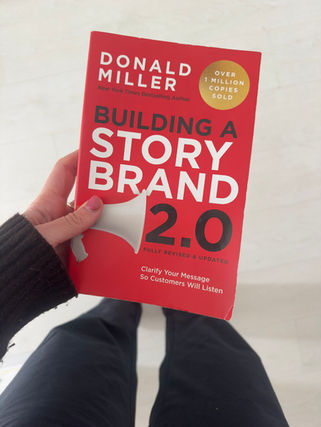
In contrast, long-form content, like Substack and YouTube, or god-forbid reading a real book, strengthens cognitive focus, deep thinking, and information retention. Giving yourself time to engage deeply with one subject means you can reflect on that topic, think critically, and work through your thoughts. Meaning you can actually take in information, learn from it and apply it to your own life or business rather than forgetting what you watched 30 seconds later. I try to follow consuming long-form content with a walk or space to further digest it—my main lunchtime routine is allowing myself 30 minutes on Substack, reading a mix of articles I’d saved for later, followed by a 30-minute walk without headphones. By taking the time to properly think through something, I can then really reflect on whether there are any good takeaways for my brands or on how I could approach any problems raised in a different way.

2. Look for inspiration outside your area
With this, I am more focused on business strategies than aesthetics. Unfortunately, taking photos of the streets in Lisbon and using the orange and yellow colour palette as inspiration for your own branding for your interior design business isn’t going to be the original thought that sets you apart, no matter how pretty it looks.
And saying you’re using Apple for inspiration for your website design when you are a videographer isn’t the right approach either.
Instead, try to think about individual parts, and look for inspiration literally anywhere but your direct competition:
Delivery models: Looking to launch a new flower subscription model? Rather than looking to Bloom & Wild or Freddies Flowers, take a look at Hello Fresh (recipe kits) or Estrid (Razor subscription) or ClassPass (exercise classes). These all have built strong cult-like followings and have used various strategies, like influencer marketing, expert blogs, and strong social proof, that you could translate into an approach for flowers.
Photography: Want to launch a new sportswear brand? There’s no point copying Tala, Nike, or Sweaty Betty's style, as each is unique to them. You could instead take inspiration from different props, like Damson Madder did, putting their models on trampolines. Or from how Boden uses bright coloured walls as backdrops for ecom photography. Or go completely outside your world and think about how you could use the same bright, high-energy approach that T-Mobile uses in their imagery.
3. Think about the hidden problems
Beyond simply solving problems differently, there are thousands of completely different problems waiting to be solved.
The problem with your performance could actually be the problem you’re trying to solve, rather than how you’re approaching it.
There are so many examples of (now) very successful companies that originally worked on different customer problems. Pivoting when they had the data or idea to support an entirely new direction. Two of my favourite stories to illustrate this are tools we come into contact with, knowingly or otherwise, on many working days.
Like this? I’d love it if you subscribed!
Shopify: The founders originally sold high-quality snowboarding gear. But they couldn’t find a simple, all-in-one e-commerce solution, so they found it difficult to build their online store, process payments and manage customer data. Once they realised other merchants faced the same issues, they pivoted to selling a software platform they themselves needed. Even after their 2006 launch and securing capital from their circles, they still had a tricky start and had to make a few other pivots in their first few years. Now it holds over 10% of the global e-commerce software market, with about 6 million live websites actively using it.
Slack: Another ‘accidental’ product. A company named ‘TinySpeck’ was developing a digital game which failed to gain traction. Whilst building it, though, they developed a very good internal chat tool that they used for remote work, and began to realise it was more valuable than the game itself. It went on to be acquired by Salesforce for $27.7 billion in 2021.

4. Give yourself space
Perhaps the most important of them all is to give yourself space to think. I am not saying you need to book a trip to China (though I would definitely recommend it). But you do need to give yourself time away from all the noise.
Inspiration is supposed to be exactly that.

If you’re inspired but don't go on to do anything with that inspiration, you aren’t doing it right.
Inspiration looks different for everyone, so what inspires me could well have no relevance to you. But you’ll never know if you never let yourself sit with the thought long enough to establish a view.
Keep consuming content, of course. (Unless you’re a better person than me, who can actually go through with a content detox). But also make sure you’re giving yourself the same amount of space to create away from that noise, and to turn the inspiration into something of your own.
Feeling inspired?
Stop reading and start creating! Or just look up long enough to properly take in the world around you.
Don’t let your inspiration go cold the way my Subway (which arrived 15 minutes ago and is, of course, toasted) is.
Like this? I’d love it if you subscribed!


