Why your business isn't growing

Updated: May 22
Most business owners I meet in January fall into two categories: those panicking about setting goals for 2026 because they need to boost growth, and those energised by the new year, excited to expand but unsure where to start.
Essentially, they all want growth but lack clarity on how to achieve it.
The main difference is emotional.
Entrepreneurs who feel their business isn’t growing and panic tend to obsess over minor details and blame specific issues like their service guide or sales pages. Simply reworking these small parts without changing strategy won’t fix the bigger picture.
Conversely, those full of New Year’s enthusiasm focus on major, sweeping changes, which can quickly become overwhelming.
Having experienced both, I believe that fixing every small detail or tackling an endless list of big tasks isn’t effective.
Instead, I suggest identifying a few key actions that can significantly improve results.
From my experience with my own business and others, three main reasons stall growth: you’re not addressing the right customer problem, your operations aren’t optimised, and your marketing isn’t positioning you as the top choice.
You might face one or multiple of these challenges, but all growth opportunities boil down to these core areas. So if you’re eager to grow this year but unsure how, let’s explore these further.
1. You’re not solving the right customer problem
All businesses solve a problem. That’s important to say first. If you don’t think you are, you either don’t have a very successful business or you need to take a closer look at why customers buy from you, so you’re clear on the problem you’re solving.
If you’ve been receiving enquiries, working with clients, or making any sales at all, you’re clearly offering something of value.
But one of the most common growth blockers I see is a mismatch between the problem a business is built around and the one that actually drives people to decide. You can be solving a real problem, just not the one your customer prioritises when money, time, and emotional energy are on the line.
I believe there are two types of customer problems: nice-to-have and urgent.
Nice-to-have problems spark recognition; people may nod along or even understand the theory behind it. It’s something people will add to their list of things to resolve in the future. But something they can continue on without.
Urgent problems are ones that disrupt someone’s day-to-day reality. They’re maybe attached to consequences, deadlines, or a discomfort people actively want to escape.
The same problem can fit into both categories at different times of the year. In December, not knowing what workouts to do in the gym was absolutely not an urgent problem for me because I was absolutely not stepping foot in a gym. But come January, it suddenly became an urgent problem when I, like the rest of the world, wanted to get fit again and needed help figuring out what to do. So I bought a subscription to a fitness app, which gave me clear workouts to follow.
It can also be location-based. When I am working from home, Pret isn’t solving any real problems for me. I have a coffee machine at home, likely have ingredients in the fridge or cupboard to pull something together for lunch. But if I am going to meet a client in the city? You best believe tracking down a coffee in the morning, or a sandwich at lunchtime, becomes an urgent problem they’re then there to solve.

Problems, of course, come with nuance, but you need to be solving a problem that’s urgent at least some of the time for your target customer. That’s because urgent problems are usually budget attached. The cost of not solving the problem feels higher than the cost of addressing it.
Continuing with an unsuccessful business is more costly than getting a strategist in to turn it around.
The £40 cost for an app to tell me how to get my dream summer body is worth it compared to never getting that summer body (February me might think differently).
The (absurd) cost of £8.19 for a Pret lunch is less of an issue than me turning up to a client meeting without having lunch in me.

So step out of your offer for a moment and step into your customer’s context. Try reflecting on these questions:
A) What was happening in their life right before they came to you?
Were they overwhelmed? Stuck? Under pressure? Trying to avoid a specific outcome? Responding to something out of their control? Simply in central London and in desperate need of a snack?
Often the trigger that brings someone to your work isn’t necessarily the aspirational goal you talk about or what you can deliver, but instead the discomfort they’re trying to move away from.
Which leads to another question:
B) What is your customer trying to avoid?
Are they trying to avoid burnout, stop their business from continuing on a downward trajectory, stop feeling bad about themselves, or avoid failing at X or missing out on Y?
And finally:
C) If your offer disappeared tomorrow, what would they replace it with?
Not necessarily what they should replace it with, but what they actually would. Perhaps a cheaper alternative or a DIY solution. Or maybe doing nothing. For example, if you’re a PT, they could replace you with an AI app rather than another PT.
This will help you to understand the urgency of your problem, and in what seasons or locations or other circumstances it could then be urgent for your customer.
Like this? I’d love it if you subscribed!
2. You’re not positioned as the best option for someone
Being British, I understand the discomfort of talking about yourself extensively or claiming to be the best. But if you want to be successful, it must be done.
There’s layers within this, and marketing itself is a whole field with its own strategy. But generally, I notice marketing struggles when a business faces problems with positioning or repetition.
A) Positioning.
Sustainable growth involves making intentional choices about where to focus energy instead of chasing every opportunity. Positioning works similarly: if you try to appeal to everyone, no one feels addressed, and your messages won’t resonate.
As well as needing to be specific about the problem you’re solving, you need a really clear understanding about who you’re solving that problem for, and why they need your solution. How are you positioning it in the market?
For service providers especially, lots of this is down to confidence. If you don’t truly believe you’re the best at what you do, it will show in your marketing, and your audience will doubt it too. Find ways to demonstrate that you’re the top choice. Whether through sharing insightful articles related to your field, explaining the quality of your offerings, or sharing case studies. You’ll want to ensure your marketing leaves no doubt in anyone’s mind that you are the best.
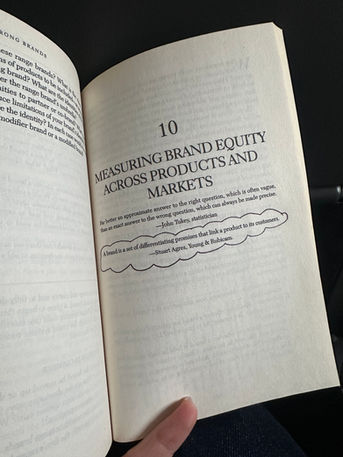
When you have that messaging sorted, it’s down to:
B) Repetition.
Many businesses approach me, believing they’ve already explained their offer and are worried about being repetitive or annoying. This is because they’re scrutinising every piece of marketing daily. Whilst their audience is having a completely different experience.
Customers might see just one post or scroll past an ad quickly, making split-second decisions about what catches their attention. Most of your audience will never see your entire marketing effort. Even if you feel you’ve repeated yourself a hundred times, most people have only heard it once or twice. To generate results from your marketing, you need to be repetitive. You need to regularly reinforce who you are, what you do, and why you’re the best. If people find it annoying, they likely weren’t going to be your customer anyway.
Like this? I’d love it if you subscribed!
3. You’ve not got the right operations in place
Your operations form the essential backbone of business growth. If you’ve successfully identified your customer base and the core problem you address, and consistently market yourself as the best solution, you should see steady, significant volume flowing into your business.
But do you have the proper operations and systems in place to support this influx? Is your expected growth truly sustainable? This involves not only handling increased volume but also maintaining your high standards of quality, ensuring all customers remain satisfied and valued.
As a side note, I’ve placed this as point 3 for the flow of the article (since points 1 and 2 are more closely linked in explanation), but in truth, I consider this your second priority to address, above marketing. It can be frustrating to set up your operations in advance of their necessity, but that’s exactly when it should be done. Addressing your operations after a surge in enquiries or customers is usually too late to ensure everything runs smoothly.
What operations are required for your business will be completely unique to your product or service and how much you want to be involved.
But I would recommend thinking about…
A) Capacity
Can you deliver more without sacrificing quality?
For service businesses, honestly assess how much time, attention, and energy each client needs and how many you can take on.
In group programmes, larger numbers often decrease relationship quality.
Selling products at higher volume brings more orders, queries, edge cases, and returns.
B) Processes
Growing businesses need less friction. If each client step or update must be redone, your business depends heavily on you. At a small scale, that’s manageable, but as demand grows, it’s often unsustainable.
Spot where you repeat yourself: explaining the same thing, answering questions, or rebuilding documents. Then create repeatable processes to free time for more complex tasks.
C) Technology
Good tech saves time, reduces errors, and improves customer experience. Use tools to support your business, but only adopt new ones that solve a current, real problem. Avoid distractions from hypothetical future needs, and instead note potential improvements for later.
D) Day-to-day tasks
Consider daily operations like inquiries, emails, marketing, sales calls, content, admin, and website management. These consume time and energy. As demand increases, plan to cut, batch, or support tasks. Don’t assume you can handle it all without sacrificing work-life balance.
E) Future improvement
Ultimately, your goal is to grow your business in a way that it can adapt over time without needing a total overhaul each year. To achieve this, it’s important to regularly review what’s working and what isn’t, and to pay close attention to client feedback. Making small, consistent adjustments enables your business to evolve alongside you, so you won’t have to revisit these issues again in 2027.

What’s your core focus area?
It’s easy to feel overwhelmed or overly excited, leading to a long list of ‘fixes’ or improvements for your business. However, most issues boil down to three main areas:
1. clearly defining your customer and the specific problem you’re solving
2. Streamlining your operations for smooth functioning
3. Positioning yourself as the top solution in your marketing.
So, if you’re facing growth challenges, instead of reworking everything, ask yourself which of these areas is currently limiting your business. You don’t need to think through every detail in that area yet. Decide what matters, then focus on identifying the specific aspects you need to improve to guide your next steps and turn things around.
Like this? I’d love it if you subscribed!


