Google can now call your competitors. Is it going to call you?

The answer to what brands do about the biggest Google search announcement in 25 years is less, not more.
We’re now living in a world where there’s a realistic chance that your next customer never visits your website.
They never landed on your homepage after clicking into it from the Google Search Results, and potentially never even scrolled through your Instagram.
The new reality is that potential clients could type a question into Google, like “find me a dog groomer in Leicester who can take a cavapoo on a Saturday morning, for under £50”. And Google’s AI can research and call three local businesses on their behalf. Confirm pricing, check availability, and book the one that ticked all the client's boxes.

This is just one part of what Google announced at I/O 2026 last week. And it’s rolling out from this summer for beauty, home repair, and pet care, with more categories to follow.
I’ll come back to what that actually means. But first, let’s talk about what most brands are going to do with this information.
So what are brands going to do with this information?
Panic.
Every time Google does something significant, there’s a predictable cycle that naturally starts with panic (don’t worry: as a web designer myself, I had that same gut reaction).
Then comes the scramble to add on more service options, write more descriptions, chase more reviews. After all, we’ve repeatedly been told that the more information we can give AI the better, right? The more places we can show up, the more the bots will notice us?
I’ve watched this happen enough times (albeit with smaller changes) to know that brands that respond to platform shifts by doing more almost never come out ahead. The ones who win are the ones who take a moment to understand what actually changed, and then get clearer, not busier.
So let’s break down what’s actually changed, and what I would tell you to actually do about it.
Google is doing its biggest update to search since it launched.
At I/O 2026 last week, Google launched some borderline unbelievable updates to how search will function. With the first changes rolling out from today (Tuesday 26th May), and most rolling out over the course of this year. With the goal of restructuring the entire relationship between a customer’s question and your brand’s answer.
Here are the five things worth understanding:
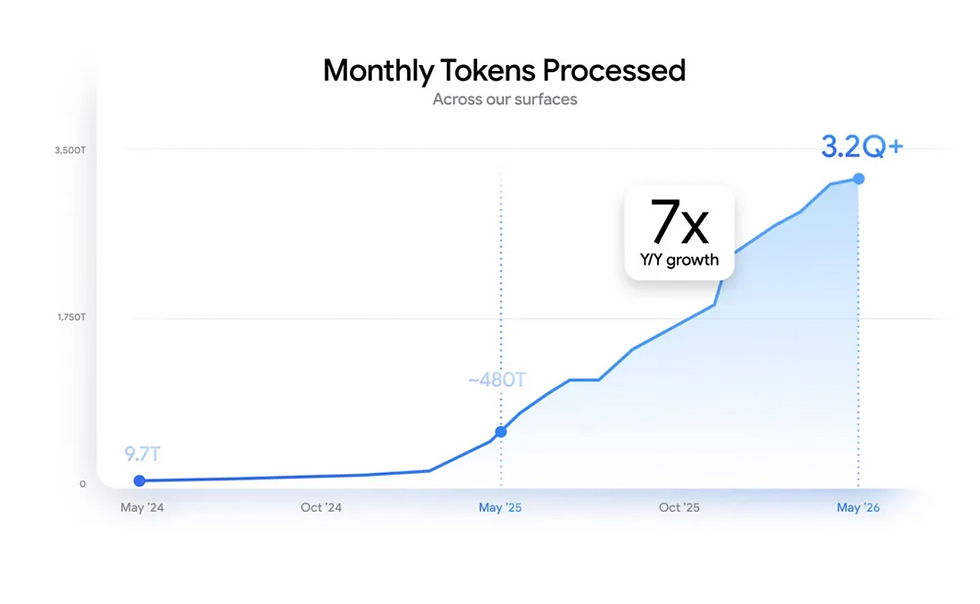
Google AI Mode now has one billion monthly users. Queries are doubling every quarter, and search volume hit an all-time high last quarter. That data is a bit skewed, as whereas previously we’d search once and research ourselves, we’re now asking more follow-up searches on the same query to the AI tools we are using. But either way, there’s no doubt that people are searching more than ever.
The Search box just had its biggest redesign in over 25 years. It’s now multimodal, meaning customers can search using text, images, files, videos, or even a live Chrome tab. Someone can hold their phone up to a product in a shop window and ask Google to find the same thing cheaper, or have your website open in Chrome, just to ask Google for alternatives. The starting point for discovery has fundamentally changed.
Search agents are here. Users can (soon) set up AI agents that run 24/7 in the background, scanning the web, social media, real-time shopping data, and news, and notifying them the moment something they care about changes. One of the main examples Google gave for this was searching for a specific pair of trainers in your size that's on sale. Your AI agent can continually watch the entire web, monitoring stock levels and pricing, and report back when it finds the perfect pair, even adding it to your bag so you can just pay. Which also takes us onto…
Google built a universal shopping cart. The Universal Cart follows customers across Search, Gemini, YouTube, and Gmail. Add something from a YouTube video, find a better deal on Search, check out via Google Pay. The entire purchase journey can now happen without a single visit to your website. Nike, Sephora, Target, and some Shopify stores (including Fenty and Steve Madden) are already in. AI Overviews now appear in over 40% of shopping searches, and products with complete structured data see 30% higher click-through rates in those placements.
And yes: Google can call businesses for you. For select categories, customers can share their criteria (”private karaoke room for six on a Friday night in Manchester, near Deansgate, that serves food late”) and Google handles the research and booking. For beauty, home repair, and pet care specifically, Google will literally phone businesses on the customer’s behalf to check availability and price. (Supposedly coming from this summer, starting in the US first).
Basically, Google is inserting itself into every step of the customer journey, and doing large parts of it on the customer’s behalf. And here I was, only a few months ago, saying that Google seemed a bit behind in the AI game…

So what does this mean for your brand?
Everyone is talking about what Google does now. Very few people are talking about what Google is now. Which is, effectively, the world’s most powerful personal shopper, making recommendations on behalf of a billion people a month.
And when you’re a personal shopper recommending a product to someone, there’s only one question that matters: how confident am I that this is the right choice for this person?
The brands that get recommended are the ones the AI is confident about. Ultimately, it’s desperate to please you (we’ve all seen the AI hallucinations). And that is something brands can use to their advantage.
AI’s confidence is built from a very specific set of signals: complete and accurate product data, strong review profiles, consistent brand presence, clear positioning, and recognisable authority in a category. In other words, they’ll recommend the brand that's clearest to them.
A brand that is easy to understand, well-reviewed, and clearly positioned for a specific type of customer is exactly the kind of brand an AI feels confident surfacing. A brand that is trying to be everything to everyone, with inconsistent data across platforms and a vague point of view, is the kind of brand that gets filtered out before the recommendation is even made.
This is, somewhat ironically, the same principle that has always made businesses interesting, and I’ve repeatedly talked about the same concept of finding your intersection in order to stand out. The brands that stand for something specific attract the right people. The brands that try to appeal to everyone often reach no one.
And AI has made the commercial cost of ignoring what makes you different significantly higher.
How can you be clear for the new Google Search?
There are three places I’d recommend service-based businesses get clear on.
1. Get reviews
This has always been a #1 ‘hack’ for SEO, and so nothing here is changing. Your reviews remain a showcase of your authority. When Google’s AI is deciding between three dog groomers to call on behalf of a customer, reviews are the primary evidence of trust, over you just stating your 5-star rated on your homepage. Ask all of your past clients for a review if you haven’t already. And then follow up to ask again.

2. Get clear on your positioning
Again, this is not new. But your positioning is your algorithmic advantage.
A brand that owns a clear, specific space is easier for an AI to match to the right customer. “Sustainable activewear for women who run ultramarathons” will have limited returns compared to the broader term “women’s sportswear”. Historically, very few people ever scrolled to page two of a Google Search Results page anyway, but now that figure will be 0, so if you’re not one of the top options for your positioning, you need to go deeper.
The more clearly you define who you’re for and why, the more accurately the AI can put you in front of the right people.
3. Think about your end-to-end experience
Your systems are now more important than ever. The Google-calling-businesses feature is only useful to a customer if the business on the other end of the phone can actually answer the questions the AI is calling to ask.
Most of this is again, nothing new (are you sensing a theme?). But you need clear pricing on your website. You should have a bookable calendar. And display all the important information, like your opening hours. Coming back to the point around how AI wants to please you, it likely simply won’t bring back options if it can’t confidently state they meet the customer’s needs. So if someone is asking for a dog groomer at a certain price point, or with availability on a certain day of the week, it won’t even consider returning you as an option if it can’t verify that information.

What can you do first?
I know there are a lot of angles in here, and the temptation is to try to fix all of them at once. But this is not the time to panic and try to do everything.
Ultimately, everything that sets you up for success with an AI bot search is the same as what improves your conversion for a human search. Your customers probably already searched with a price point in mind, a specific day of the week they’d like appointments, or a specific shoe size. We just didn’t often put that information into our actual search; it was just in our minds as we switched through different tabs.
It remains true that overdoing your business will only confuse your customers (or soon, their AI agent).
So start with those three basics: display reviews, get clear on your positioning, set up your end-to-end experience.
And then think about how you can do less, rather than more. How can you be really specific about exactly what you do? Exactly who you’re there to serve? And why are you the best option for your customer?
It may seem like everything is changing. But the foundations for success in search remain largely the same.
If you’re working on brand strategy or business positioning and want to think through what this means for your specific business, reach out to me today.


