What if your product was the proof?

Convenience has become the focus of many recent discussions. Our world is so heavily ‘optimised’ that we are removing the imperfect elements that actually make it special. And whilst most people I speak to share that sentiment, the data suggests otherwise. Customers are increasingly talking about values and desires, but our actions are telling a very different story.
There’s widespread online outrage against AI, yet most who have access use it regularly.
Environmental concerns are increasingly discussed, as fast-fashion consumption increases.
We’re all aware of the new alarming side effects of Ozempic being released on a daily basis, yet I hear about more acquaintances starting to take it just as often.
We may desire many things, but our actions reveal that convenience is what we truly prioritise
So what if brands solved the deeper problem behind why we can’t follow through with our values?
That’s exactly what my new favourite brand, Modern Milkman, has done.

“A milk round with a mission to reduce plastic waste.”
Modern Milkman was founded in 2018 by Simon Mellin, a Lancashire-born serial entrepreneur who’d spent years in the food and farming industries. The catalyst, supposedly, was Blue Planet II (the TV series), in which Mellin was shocked by what single-use plastic was doing to the oceans, and decided to rebuild the milk industry around a solution.
The resulting business now works on a closed-loop system. Groceries and breakfast essentials (starting with milk but now expanding well beyond it) can be delivered to your door in glass bottles with reusable lids or recyclable packaging. When the bottles are finished, you leave it outside your door, where they’re collected, washed, refilled, and sent out again.
They cover all ‘essentials’, maximising your convenience by delivering them directly to your door on a recurring milk round order, whilst also maximising the sustainability of these options.
Personally, I recommend the strawberry milkshake, fresh pastries, and sourdough loaf. Who wouldn’t want that delivered (in paper packaging or a reusable glass bottle) on a weekly basis?!

It maximises convenience for the user and the business. The collection route is optimised to minimise unnecessary journeys (with deliveries and collections on specific days based on your area), and the whole thing runs on the idea that people want to do good for the environment, but in a way that matches the convenience of grocery deliveries.
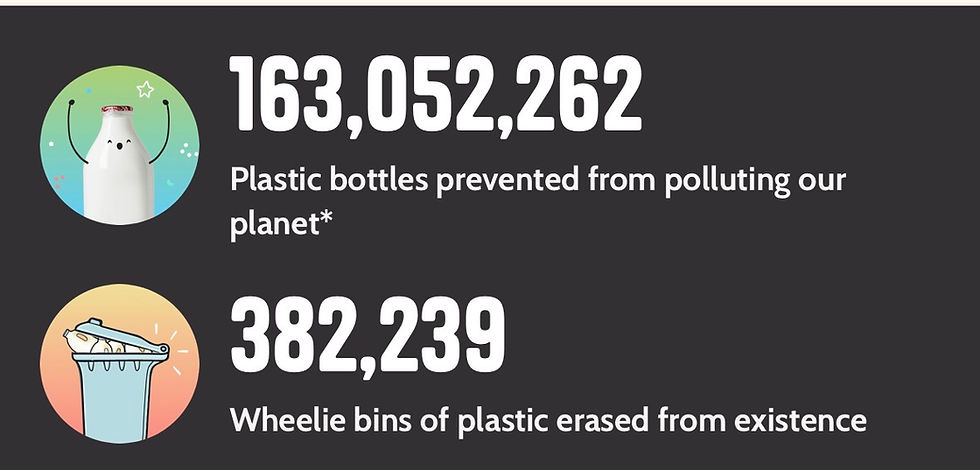
To date, they’ve saved the equivalent of over 163 million plastic bottles, or over 382,000 wheelie bins of plastic.
To know that I’ve been a part of that, whilst actually saving myself less trips to Tesco, is a big win-win. And that’s exactly how they want their customers to feel.
Their business model is their argument
It’s an undoubtedly great business model. But what makes it great is that their entire product is built around the proof that they care about their argument.
Most sustainability businesses put their values in a paragraph on their about page, or scrape by through doing the bare minimum to allow a few products to be tagged as ‘recyclable’. There’s a whole host of fashion brands calling themselves eco-friendly whilst still using synthetic fabrics and hosting bi-monthly promotions to drive more sales (don’t even get me started). And as consumers, we often just let our values slide a bit in the name of convenience (and price, and other factors, of course. But no one feels fundamentally good about shopping on Amazon).
Modern Milkman doesn’t present that problem because their business model is their argument. There’s no gap between what they say and what they do, because the doing is the whole point.
They don’t need to have sustainability claims printed on their bottles, or even on their app, because the glass bottle itself is the message.

The winning intersection
If you’ve read any of my other articles, you’ll know that I believe interesting brands all sit at intersections: a combination of factors that positions them in a unique space.
In Modern Milkman’s case, they’ve built their business at the intersection of sustainability and convenience. Two things that rarely cross over in modern times.
Plus, there’s a healthy dose of nostalgia. Milk rounds, of course, existed years ago. At its peak in the 1970s, roughly 94% of milk in the UK was delivered to doorsteps. The model died off primarily because supermarkets got cheap and people began to prioritise convenience. Mellin didn’t invent anything new; he just realised the old model was already the answer to a new problem. One he could add his Modern twist to.
Modern Milkman removes the friction for being sustainable. The doorstep delivery means you don’t have to go anywhere. They have a super-easy app where you can manage your order until 6pm the night before. Collection happens automatically, and I even have repeat deliveries set up, so I don’t often have to think about it (fresh milk and croissants every Thursday, that I can feel good about for eating, thank you very much).
The sustainable choice is, structurally, the easier choice than the common one. Which is never usually the case.

Their customer is the evidence
Most brands want loyal customers, but Modern Milkman needs them.
Unlike the catch-22 situation most ‘sustainable’ companies find themselves in, where the more sales they have, the less sustainable they are, the opposite is true for Modern Milkman.
The more times their glass bottles can be reused, the better. The more customers they can serve on their existing routes, the better. And the more customers they can switch from disposable packaging to renewable, the better.
The cumulative 163 million+ plastic bottles avoided is a collective achievement by both the company and its customers. Every doorstep return adds to that number, and the customer can truly feel like they’re part of a wider movement. Whilst the business becomes more credible as it grows.

What does this mean for you?
Modern Milkman is an interesting business because it has built a system that makes its mission visible every single time it works.
Rather than just stating their values, it’s visible in every part of the business, from packaging to delivery options to the products you can buy. And that is the bit too many businesses skip.
Often, a business knows what it stands for and defines it clearly, but then struggles to actually act on it. The product, the service, and the customer experience all remain the same. And the values end up serving as decoration rather than direction, adversely impacting the brand.
Modern Milkman started by challenging where their belief shows up, rather than how to communicate. And it’s worth asking that about your own business.
Could your values influence the way your product functions?
Could they change how customers interact with it, or what happens after they buy?
Could they show up in a decision you make about delivery, pricing, packaging, or processes?
I’ve already written about how Tony’s Chocolonely’s built their belief into the shape of their chocolate bar. Modern Milkman has built theirs into their logistics. Neither of these brands needs a campaign to explain what they stand for, because their business does it for them.
The brands that stay interesting are rarely the ones with the best mission statement. They’re the ones where their real-life customers can point at something like a product or a core moment in the customer experience, to explain to their friend exactly what their favourite brand stands for.
If your customers can’t do that yet, that’s where your work is.
P.S: Use my code to get 50% off your own Modern Milkman round!:
LUCY-1-1CA5DB


